What Laimonade is
Laimonade is an AI Product Owner for coding-agent teams. It grooms the backlog, runs sprints, hands agents work orders over MCP, and only a person marks work done.
Last reviewed · maintained by Founder
What is Laimonade?
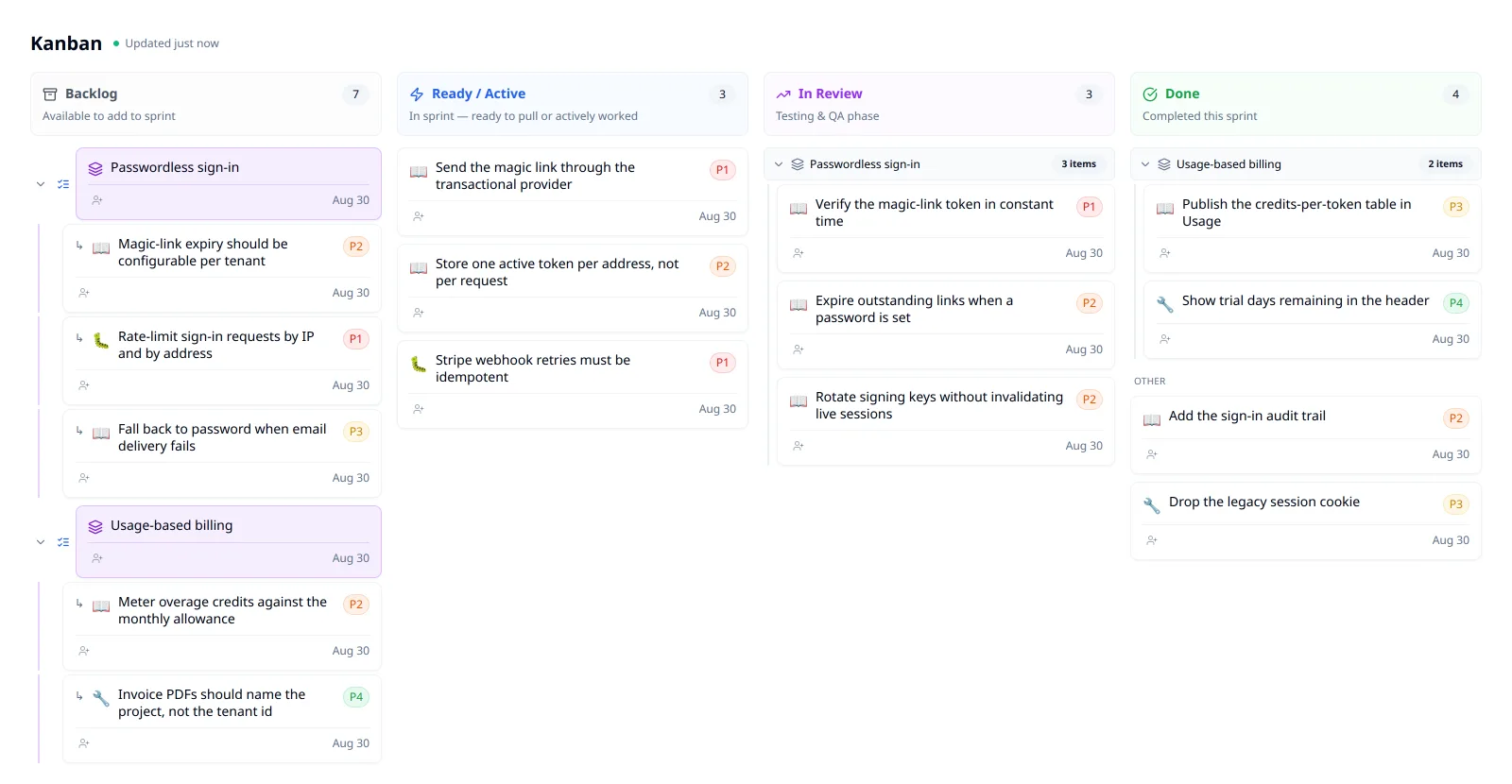
Laimonade is an AI Product Owner for software teams whose code is largely written by coding agents. It owns the layer between deciding what to build and verifying what came back: grooming the backlog, planning a weekly sprint, handing agents work orders over the Model Context Protocol, and receiving that work back for review with a record of what the agent actually ran.
It does not write your code. Claude Code and Cursor already do that well, and Laimonade is built on the assumption that they will keep getting better. What does not get faster on its own is the work of deciding what those agents should build next and writing it down precisely enough that they can act on it without a person translating.
What is an AI Product Owner?
An AI Product Owner is software that performs the product-owner role rather than recording it: it turns intent into work items an agent can execute, keeps the backlog in that state as things change, decides what belongs in this week's sprint, and checks returned work against the criteria the item was accepted on.
The distinction that matters is between a tool that stores decisions and one that makes them. A backlog tool holds whatever you type into it, at whatever quality you typed it. An AI Product Owner reads a two-line request, asks what is missing, writes acceptance criteria a machine can be held to, attaches the regression notes for the files about to change, and refuses to call something finished because a commit mentioned it.
How is Laimonade different from Jira, Linear or Asana?
Those tools are systems of record: they hold the items a human wrote and show them in useful arrangements. Laimonade is a system of action — it writes and rewrites the items themselves, then serves them to agents in a machine-readable form over MCP.
Three practical differences follow from that:
- The unit of work is written for an agent, not for a standup. An item carries acceptance criteria, the repos and paths it touches, its dependencies and the regression invariants for that area. "Fix the login bug" is a starting point, not a ticket.
- Nothing waits for a person to relay it. A connected coding agent reads the Ready column itself, loads the item in full, and hands the work back for review when it is done.
- Closure belongs to a person. An agent can move an item as far as In Review and no further — the executor refuses any attempt to set Done. What it hands over with it is a record of the checks it ran, so accepting the work is reading evidence rather than taking its word.
How is it different from just using a coding agent?
A coding agent is excellent at the task in front of it and has no memory of your roadmap. Ask it to "keep going" and it will pick something plausible. Laimonade is what decides which task is in front of it, and why that one.
Concretely, it supplies the three things an agent cannot get from a prompt: a prioritised queue that survives between sessions, the acceptance criteria that define done for each item, and the accumulated knowledge of what must not break in the code it is about to touch.
What Laimonade will not do
- It will not mark your work done. Agents can move an item to In Review. Deciding something is finished stays with a person — there is no tool or automation that sets an item to Done on your behalf.
- It will not give itself more to do. Unattended implementation is opt-in per item and set by a person. An agent cannot add items to that queue, including its own.
- It will not write your code. There is no code generation in Laimonade. It briefs the agents that do.
- It will not read across projects. A connection is bound to one project's backlog, sprints, roadmap and rules.
Who is it for?
Two situations, both defined by agents already being in the loop rather than by team size:
- Engineering leaders whose agents are no longer the bottleneck, and where the constraint has moved to specifying work and verifying it. See for engineering leaders.
- Solo founders who are the product owner between everything else, and need the backlog to stay in a state their agents can work from without a weekly grooming session. See for solo founders.
If your bottleneck is still generation quality or review throughput rather than knowing what to build next, Laimonade is not your constraint yet. We would rather you found that out from this page than after a month.
Where to go next
Read how Laimonade works for the model — sprints, the Ready column, and what makes an item agent-executable. If you would rather start doing than reading, getting started takes you from signup to a sprint with work in it.