How Laimonade works
The model Laimonade works on — roadmap hierarchy, calendar-week sprints, the four board columns, what makes a backlog item agent-executable, and how commits become evidence.
Last reviewed · maintained by Founder
The model, before the mechanics
Laimonade has one shape and everything else follows from it: work is arranged milestone → epic → item, and it moves through a weekly sprint one column at a time. Read this page before the reference sections. The tool list is unusable if you do not know what a Ready column is or why an item needs acceptance criteria.
How is work organised?
Four levels, from the year down to the thing an agent does this afternoon:
| Level | What it is | Who usually writes it |
|---|---|---|
| Milestone | An outcome with a target date — what the business can do once it lands | You, with Laimon |
| Epic | A body of work under a milestone, holding related items | Laimon, from your intent |
| Item | One story, bug or improvement — the unit an agent executes | Laimon, refined by you |
| Sprint | One calendar week's selection of items | Laimon proposes, you decide |
Milestones and epics exist so that finishing an item moves something visible. An item with no epic still gets built, but it contributes to no milestone and appears in no progress figure — which is why Laimonade keeps trying to parent things.
How long is a sprint?
A sprint is one calendar week, Monday to Sunday, created automatically. There is no sprint planning ceremony to run and no sprint to open or close by hand.
On Monday, in your project's timezone, the previous week's sprint closes and three things happen:
- Items still unfinished carry forward into the new week, keeping their column.
- Items that reached Done are archived with their completion date, so the board shows this week's work rather than an accumulating pile.
- The closed sprint keeps its delivered points, which is what velocity is computed from.
Archived is not a graveyard: an archived item that carries a completion date still counts towards its epic and milestone, and still appears in the archive list. That is why completion dates matter more here than statuses do.
What are the board columns?
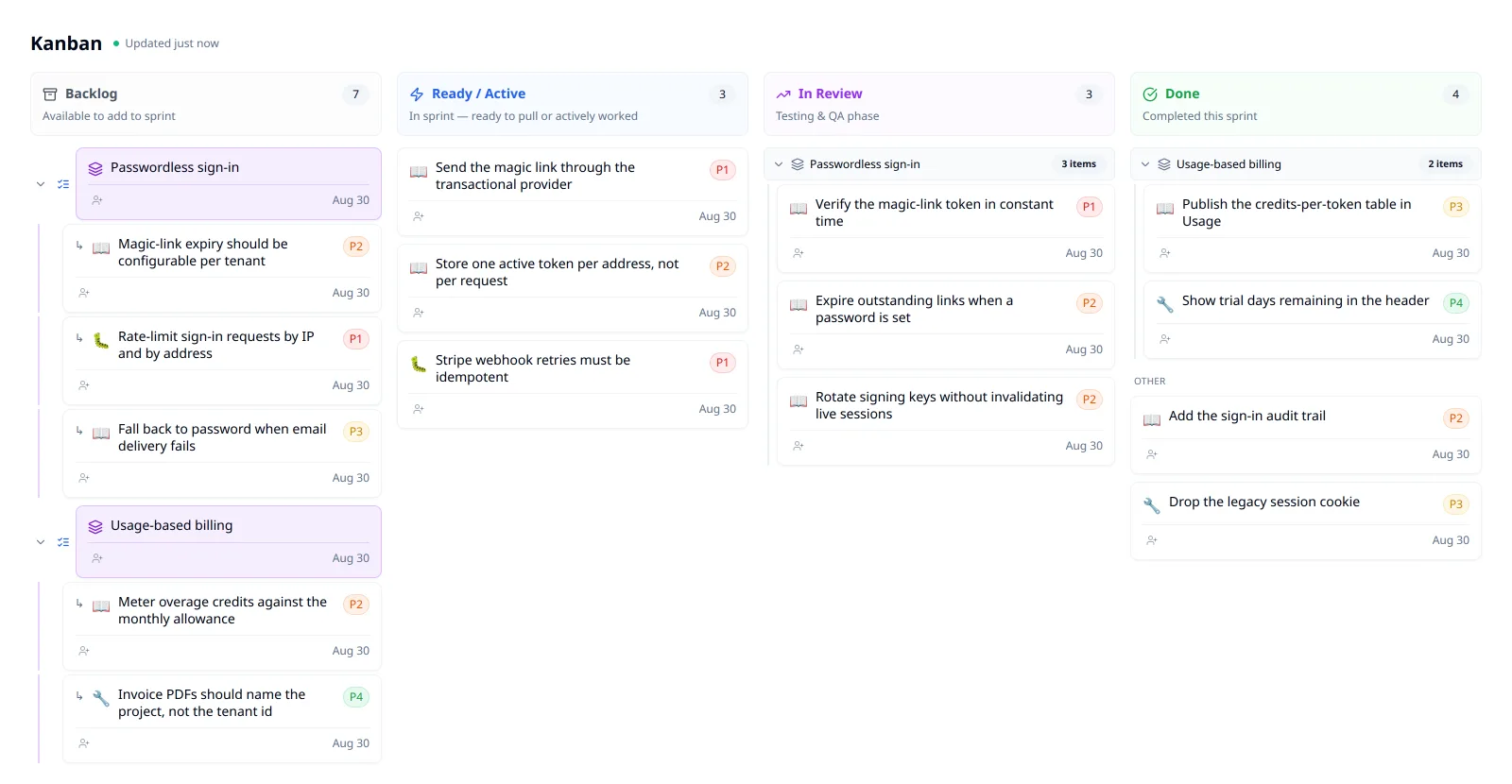
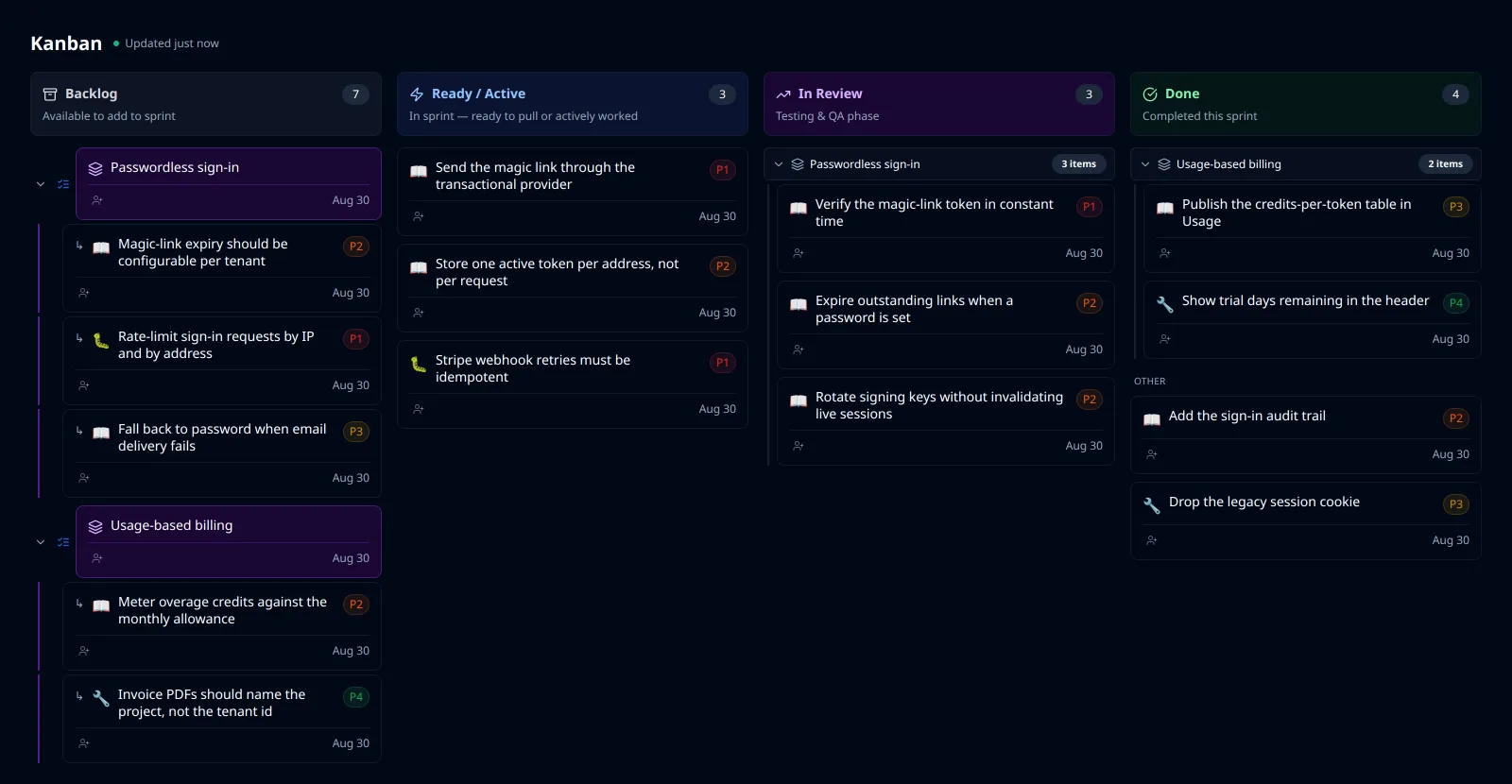
Four, and the boundaries between them are the only workflow Laimonade insists on:
- Backlog — everything not in this week's sprint. Ordered by hand, grouped under epics.
- Ready / Active — on the sprint and available to pull. This is the column a connected coding agent reads. An item arriving here should need no further questions.
- In Review — the work is claimed to be done and is waiting for a human verdict. Agents can put items here. They cannot take them further.
- Done — a person accepted it. Ordered newest-completed-first, so the column answers "what did we just finish".
What makes a backlog item agent-executable?
An item is agent-executable when an agent can act on it without asking you anything. In practice that means four things are present:
- Acceptance criteria that can be checked, not restated intent. "Users can log in" is intent; "an expired session returns 401 and the client redirects to /login once, without a loop" is a criterion.
- The blast radius: which repos and paths the change touches, and what must not break there. Laimonade keeps a registry of regression invariants per area and serves them with the item.
- Dependencies, so an item that needs another one first says so rather than being discovered halfway.
- A single change. One item, one thing. An item holding six deliverables cannot be reviewed, and an agent will do the first two and report success.
You do not have to write any of that yourself. Describing the problem in chat is enough to start; Laimon drafts the item and asks about the parts that are missing.
How does work reach an agent?
Over MCP. A connected coding agent asks for the Ready column, gets a numbered menu, loads the items it wants in full, and reads the regression notes and your project rules before it edits anything. When it is finished it submits the item for review, which asserts the acceptance criteria are met — which is why loading the item first, rather than working from its title, is the part that matters.
See connect your coding agent for setup, and the MCP tool reference for exactly what an agent can and cannot do.
How does an item get closed?
Two paths, and neither of them ends with software deciding your work is finished:
A person accepts it. Someone reads the item in In Review, checks it against its criteria, and moves it to Done. This is the only route to Done.
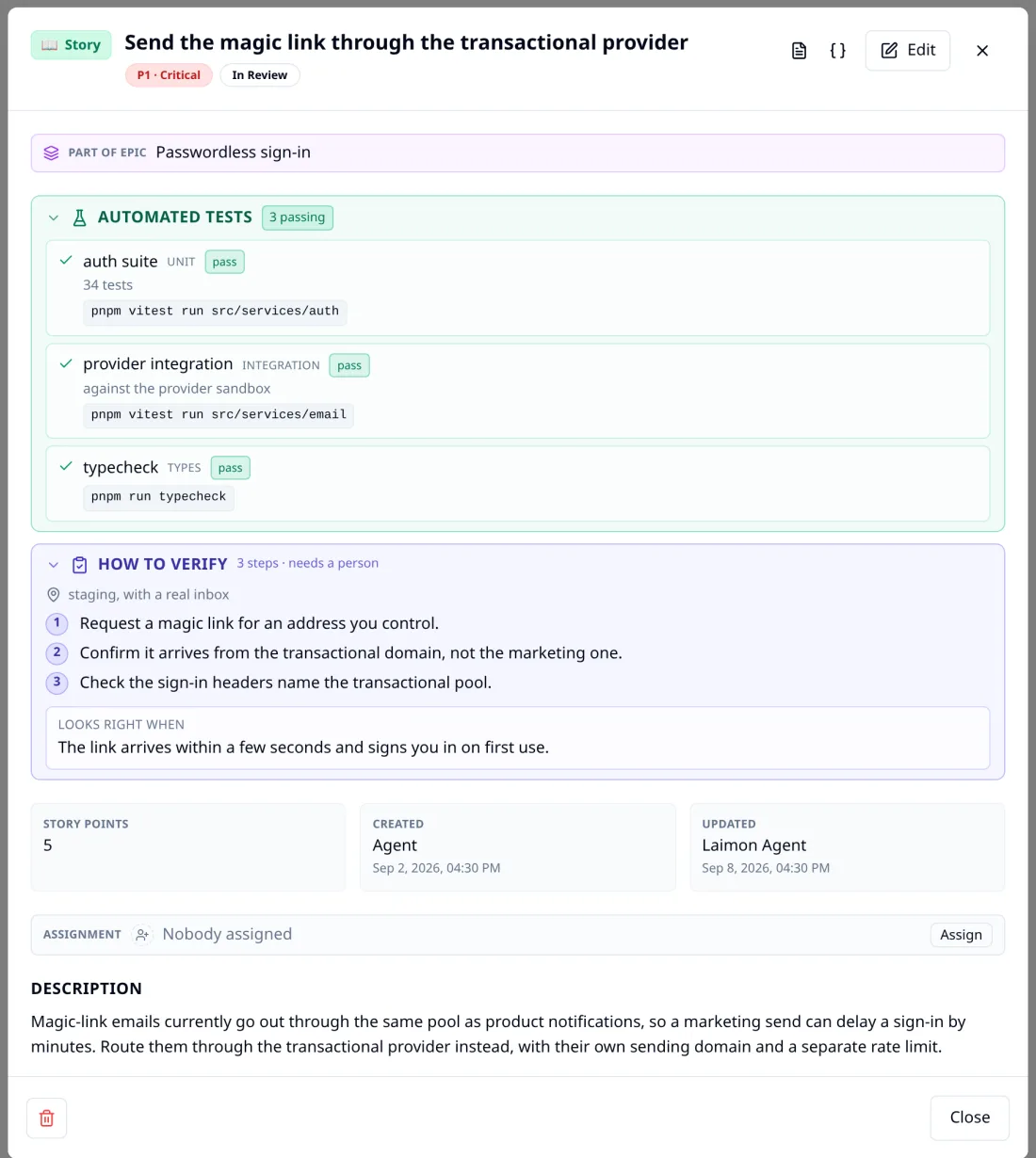
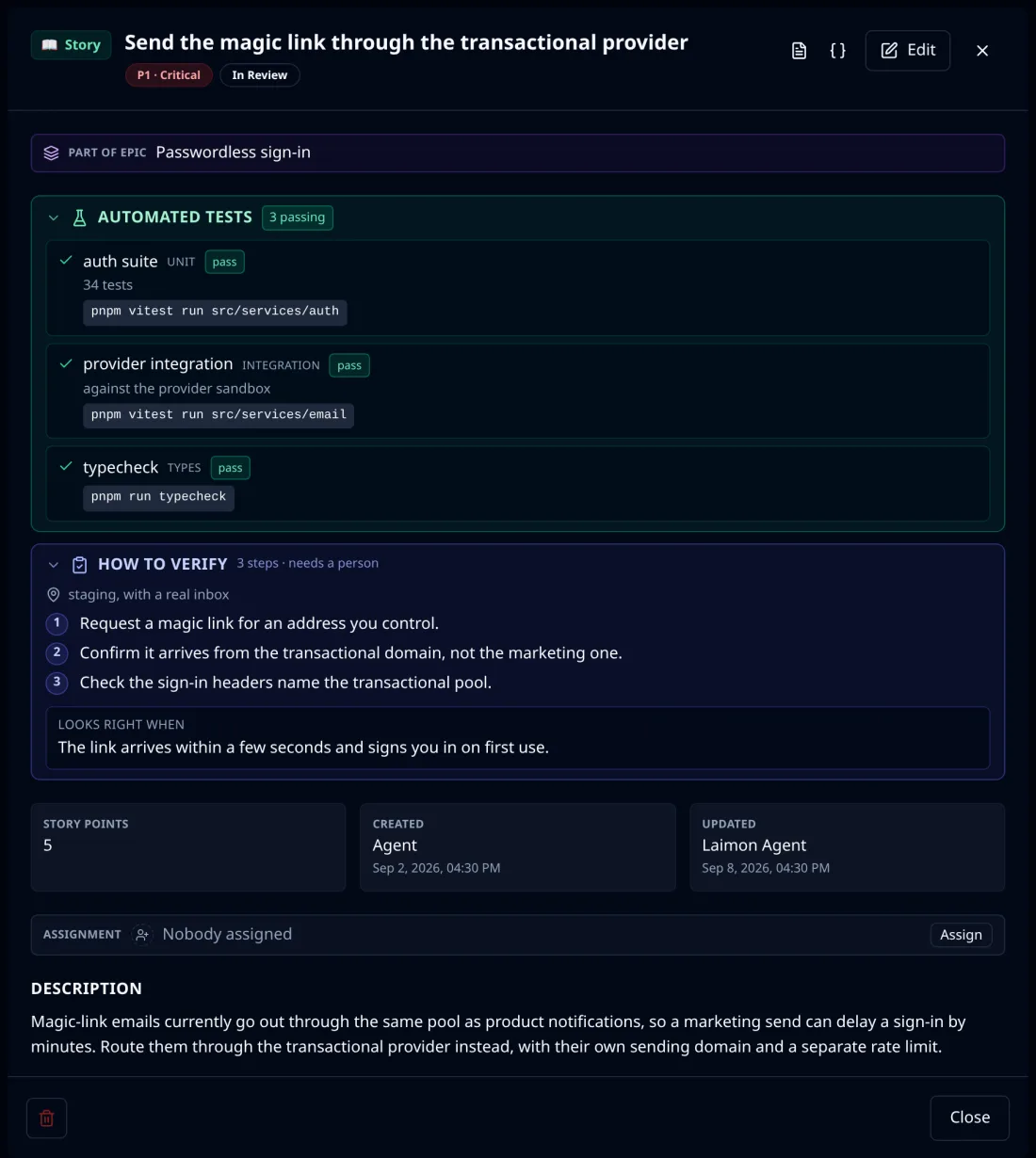
An agent hands it back. A connected coding agent moves its own item to In Review over MCP and records what it ran — the commands, their results, and the steps a person still needs to take. That attestation is what you are reading when you accept or reject the work:
Automatic commit matching is currently switched off, and it is worth being precise about that because earlier versions of this page described it as live. A scan used to read every pushed commit, attach the ones it was confident about, and draft a backlog item from the ones it could not place. It was turned off after 1,509 of 2,115 pending matches in production were never given a verdict — it asked a question almost nobody answered, on every item open.
What replaced it is the reviewed path rather than the automatic one:
- An agent or a person can attach a commit to an item on request, by name.
- Laimon can propose backlog items for commits that match nothing, for a person to accept or discard.
- Evidence already recorded on an item still reads normally — the historical record is intact.
Epics are never matched to commits. They complete when their children do.
What consumes credits?
Credits are consumed when Laimon does token-backed work for you: grooming an item, planning a sprint, writing a work order, producing a digest. Credits are metered from AI token usage only, so reading the board, moving a card and inviting a colleague cost nothing.
Credits reset monthly and do not roll over. If a plan runs out, Laimon stops taking new token-backed work rather than billing you for more. See pricing for what each plan includes.
Where to go next
Getting started walks the whole path from signup to a sprint with Ready work in it.